
Introduction: The Appointment That Never Happened
You prepared for the consultation.
You blocked the time.
You kept the slot open.
The patient never arrived.
For many solo doctors, this is not an occasional issue. It is a weekly pattern.
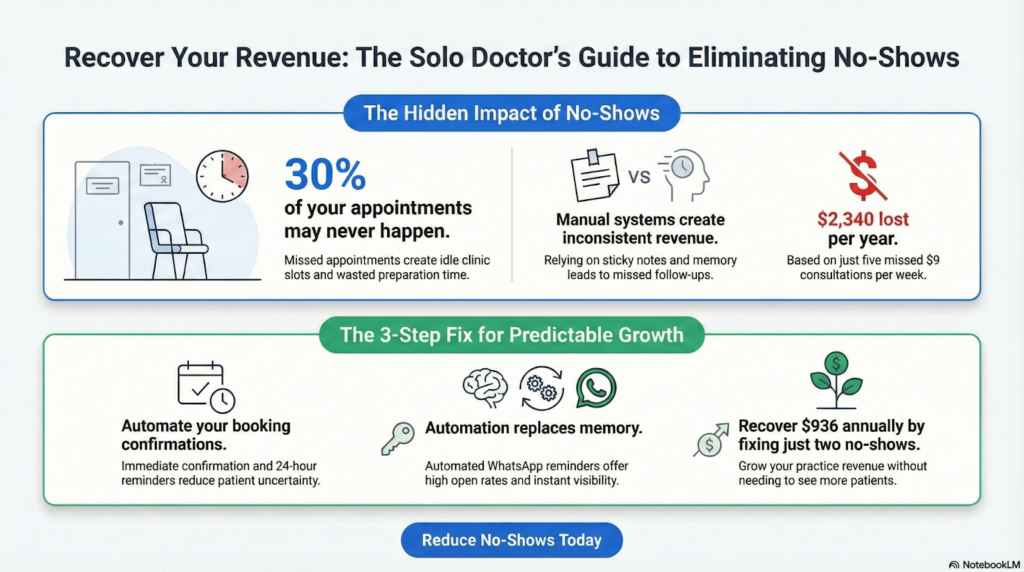
Studies and industry data show that medical practices often experience 20–35% no-show rates, depending on specialty and location.
That is not just inconvenience.
It is revenue loss, wasted time, and operational inefficiency.
The good news?
No-shows are predictable. And predictable problems can be fixed.
The Real Cost of No-Shows
Let’s start with simple math.
If your consultation fee is $9 per visit
And you experience 5 no-shows per week
$9 × 5 × 52 weeks = $2,340 lost annually
Now consider higher consultation fees or higher no-show frequency. The impact compounds quickly.
But revenue is only part of the story.
No-shows also mean:
- Wasted clinical preparation
- Idle staff time
- Lost opportunity for another patient
- Emotional frustration
Empty slots reduce momentum. And momentum matters in a solo practice.
Why Do Patients Miss Appointments?
Understanding the root causes is essential before designing the solution.
Here are the most common reasons.
1. Patients Forget
This is the most common reason.
Busy schedules, family obligations, work commitments — patients simply forget.
Without structured reminders, memory becomes unreliable.
2. No Confirmation System
Many clinics send reminders but do not ask for confirmation.
A reminder without confirmation tracking is incomplete.
If a patient does not actively confirm, risk remains high.
3. Inconvenient Rescheduling
If patients cannot easily reschedule, they often cancel silently.
Or worse, they do nothing.
Friction leads to no-shows.
4. Weak Commitment at Booking
If booking is too casual — for example, verbal agreement without confirmation — patients may not feel strongly committed.
Structured booking systems increase psychological commitment.
5. Long Waiting Periods
Appointments scheduled far in advance increase no-show risk.
The longer the gap, the higher the probability of forgetfulness or schedule change.
Why Manual Reminder Systems Fail
Many solo clinics still rely on:
- Staff phone calls
- Manual WhatsApp messages
- Sticky notes
- Verbal confirmations
These systems fail because:
- Staff forget
- Calls go unanswered
- No tracking mechanism exists
- No data is collected
Inconsistent systems create inconsistent outcomes.
The 5-Step No-Show Reduction Framework
Here is a practical system that solo doctors can implement immediately.
Step 1: Instant Confirmation After Booking
The moment an appointment is booked, send an automated confirmation message.
The message should include:
- Date
- Time
- Clinic address
- Clear confirmation option
Example:
“Your appointment is confirmed for Tuesday at 10:00 AM. Please reply YES to confirm.”
Immediate confirmation strengthens commitment.
Step 2: 24-Hour Reminder
Send a reminder exactly 24 hours before the appointment.
This timing is optimal because:
- It is close enough to remember
- It allows time to reschedule
- It reduces last-minute surprises
Keep the message short and clear.
Step 3: Confirmation Tracking
Track who confirms and who does not.
Patients who fail to confirm should receive a follow-up message.
Data-driven tracking allows proactive management.
Step 4: Easy Rescheduling Option
Include a rescheduling link or clear instruction.
When patients can easily change time slots, cancellations decrease.
Removing friction reduces silent no-shows.
Step 5: Measure Your No-Show Rate Monthly
What gets measured improves.
Track:
- Total appointments
- Confirmed appointments
- No-shows
- Rescheduled cases
Over 2–3 months, patterns will become visible.
Why WhatsApp-Based Reminders Work Better
In many regions, WhatsApp open rates exceed traditional SMS or email.
Advantages:
- Instant visibility
- Familiar interface
- Higher engagement
- Two-way communication
Automated WhatsApp reminders combine convenience with consistency.
The key difference is automation, not just the platform.
How Reducing Just Two No-Shows Per Week Changes Everything
Let’s revisit the numbers.
If you prevent 2 no-shows per week
$9 × 2 × 52 = $936 recovered annually
Without increasing patient volume.
Now add retention improvements and review growth.
Small operational improvements create large financial shifts.
The Psychological Side of No-Shows
Patients are more likely to attend appointments when:
- They receive structured reminders
- They actively confirm
- They perceive professionalism
- The booking experience feels formal
Systems signal seriousness.
Serious systems create serious commitment.
The Long-Term Impact of Reduced No-Shows
Lower no-show rates lead to:
- Predictable daily schedules
- Reduced stress
- Better staff planning
- Higher revenue stability
- Improved patient trust
Consistency creates confidence — both for doctors and patients.
Conclusion: No-Shows Are Not Random
They are not bad luck.
They are not inevitable.
They are usually the result of missing systems.
When solo doctors implement structured confirmation, reminder automation, and rescheduling pathways, no-show rates drop significantly.
Growth does not always require more patients.
Sometimes, it requires fewer missed appointments.
Frequently Asked Questions (FAQ)
1. What is a normal no-show rate for solo clinics?
Most solo practices experience 20–35% no-show rates depending on specialty and location. With proper automation, this can often be reduced significantly.
2. Do reminder calls work as well as automated reminders?
Manual reminder calls can help, but they lack consistency and tracking. Automated systems provide better reliability and measurable results.
3. What is the best time to send appointment reminders?
The most effective time is typically 24 hours before the appointment, with optional same-day reminders for high-risk clinics.
4. Should I charge a no-show fee?
Some clinics implement no-show fees, but prevention through automation and confirmation systems is usually more effective and patient-friendly.
5. How quickly can I see improvement after implementing automation?
Many clinics notice measurable reduction in no-shows within a few weeks once structured reminders and confirmations are consistently used.
6. Is reducing no-shows enough to grow my clinic?
Reducing no-shows improves revenue stability. Combined with retention systems and visibility strategies, it creates predictable long-term growth.