
Mrs. Kapoor didn’t show up today.
Neither did the 10:30 AM slot.
Or the 3 PM appointment you kept open all week.
You prepared. You waited. They vanished.
And tomorrow, it happens again.
The solo doctor trap
You see 50-200 patients a month.
You don’t have a hospital behind you. No marketing team. No IT department.
Just you, your receptionist (when she’s not on leave), and a practice you built consultation by consultation.
And somewhere between treating patients and running the business, you’re bleeding money.
Not to bad decisions. Not to poor medicine.
To friction nobody talks about.
The math nobody showed you in medical school
Let’s do this honestly.
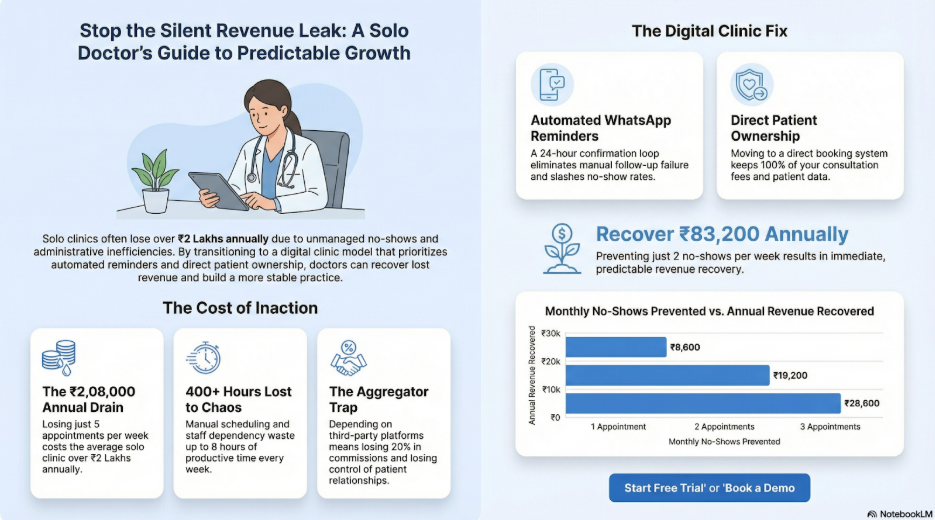
No-shows per week: 5 patients Your consultation fee: $10 (₹800) Weeks in a year: 52
$10 × 5 × 52 = $2,600 lost annually (₹2,08,000)
That’s not theory. That’s Dr. Mehta from Pune’s actual calculation last month.
But here’s what hurts more than the money:
You kept that slot open. You turned down a walk-in. You prepared their file.
And they didn’t even call.
Then there’s Practo
Yes, Practo brings patients. You know what else it brings?
15-20% commission on every booking.
50 appointments a month at $10 = $500 revenue. Commission paid: $75-$100 monthly.
That’s $900-$1,200 per year.
And here’s the kicker: those aren’t your patients. They’re Practo’s.
You can’t export their data. You can’t contact them directly. If you leave the platform tomorrow, they stay there.
You’re renting your own patient relationships.
The WhatsApp loop
6 PM. Clinic just closed.
Now you’re scrolling through tomorrow’s appointments, typing reminders:
“Hi Priya, this is Dr. Sharma’s clinic. Your appointment is tomorrow at 10 AM. Please confirm.”
Copy. Paste. Send. Repeat.
6-8 hours per week doing this.
That’s 312 hours a year. Almost 40 full working days.
Dr. Ananya in Jaipur calculated it: “I spend more time reminding patients than I do planning my practice growth.”
What changed between you and them
Your patients book Swiggy at midnight. They get instant confirmations. Auto-reminders. One-tap rescheduling.
Then they call your clinic during work hours, wait on hold, and forget to write down the appointment time.
The expectation gap isn’t their fault.
It’s not yours either.
It’s just… reality in 2026.
Dr. Priya’s breaking point
Dermatologist. Bangalore. 8 years of practice.
One Thursday, she had three no-shows in a row.
She didn’t yell. She didn’t complain.
She just opened her laptop and searched: “stop wasting time on patient reminders.”
Six weeks later:
- No-shows: 28% → 9%
- Time on admin: 8 hours/week → 2 hours/week
- Monthly revenue up: $600+ (not from more patients—from patients actually showing up)
What changed?
She stopped running her practice manually.
The patient who came back
Dr. Kumar treats diabetes patients in Delhi.
Used to see them when they remembered to visit. Maybe every 6 months. Maybe never again.
Now his system sends a message every 3 months:
“Hi Mr. Verma, it’s time for your HbA1c check-up. Would you like to book?”
Return rate jumped from 31% to 54%.
Here’s what nobody tells you: patients WANT to take care of their health.
They just forget.
Your job isn’t to be unforgettable. It’s to build a system that remembers for them.
That’s not marketing. That’s medicine.
What “digital clinic” actually means for solo doctors
Not robots. Not AI replacing diagnosis. Not losing the human touch.
It means:
Appointments book themselves (even at 11 PM when you’re asleep) Reminders send automatically (even when your receptionist is on leave) Reviews get collected systematically (without you asking awkwardly) Time comes back to you (for actual patient care)
Dr. Ananya calculated it: 8 hours a week on admin tasks. Now less than 2.
That’s 6 hours back. For patients. For family. For thinking about medicine instead of managing schedules.
The Google test
Right now, open your phone.
Type: “[Your specialty] near me”
Where do you appear?
If you’re not in the top 3 with reviews, timing, and a way to book—patients are scrolling past you.
Your medical degree doesn’t show up in search results.
Your clinical skills don’t either.
Your digital presence does.
And 67% of new patients in urban India now search before they visit.
Three solo doctors, three months, real numbers
Dr. Sharma | Orthopedic | Delhi
- Added automated WhatsApp reminders
- No-shows: 32% → 11%
- Monthly revenue recovered: $600+
- Time saved: 6 hours/week
Dr. Nair | Pediatrician | Kochi
- Set up vaccination follow-up automation
- Return visit rate: 31% → 54%
- Patient satisfaction: parents love the reminders
- “I feel like a modern practice now” – Dr. Nair
Dr. Reddy | GP | Hyderabad
- Built personal website + review system
- New patient bookings: +67% in 90 days
- Google reviews: 12 → 94
- Practo dependency: reduced by half
None hired new staff. None bought hospital-grade software. None became tech experts.
They just stopped accepting broken as normal.
The commission math that stings
Aggregator commission: 15-20% per booking
Your numbers:
- 50 appointments/month × $10 = $500
- Commission: $75-$100/month
- Annual cost: $900-$1,200
That’s not a “marketing expense.”
That’s a permanent tax on your practice—and you still don’t own the patient data.
What your patients actually want (they told us)
Not fancy. Not complicated.
- Book without calling during work hours (They’re busy too)
- Get confirmation immediately (Not “we’ll call you back”)
- Receive a reminder they can’t miss (WhatsApp, not SMS they ignore)
- Reschedule without guilt (Life happens)
Every friction point you remove = one more patient who shows up.
The review engine nobody uses
Dr. Iyer had 12 Google reviews. Good ones. But random.
He never systematically asked.
Then he started: after every positive consultation, one simple automated message.
“Your feedback helps other patients. Would you mind sharing your experience?”
Six months later: 180 reviews. 4.8 stars.
New patients specifically mention reviews during first visit: “I read what people said about you.”
Reviews aren’t vanity. They’re trust in searchable form.
The pattern that works for solo doctors
Stop the leak → Fix no-shows first (you’re losing ₹2L+ per year here)
Own the relationship → Get patients booking directly with you, not through middlemen
Build the system → Automate what drains your time
Create visibility → Show up when patients search + build reviews
Improve retention → Bring patients back systematically
Each piece supports the others.
Miss one, you’re still firefighting daily.
What this isn’t about
This is NOT about:
- Becoming a tech company
- Replacing your judgment with algorithms
- Spending hours learning software
- Losing personal connection with patients
This IS about:
- Getting your time back for medicine
- Stopping daily frustrations that drain you
- Building income that’s predictable, not random
- Strengthening patient relationships (not weakening them)
The system handles logistics.
You handle care.
That’s the deal.
The invisible cost solo doctors carry
Every no-show is $10 you can’t recover.
But there’s something worse:
The mental tax.
The “Did they forget again?” The constant follow-up. The feeling that half your day is chasing, not treating.
Dr. Malhotra said it perfectly:
“I became a doctor to treat patients, not to chase appointments. I wanted my energy back for medicine.”
Why this matters now (not someday)
Because patients changed already.
They book hotels at 2 AM. They order food in three taps. They expect things to work.
And when your practice doesn’t match that expectation, they don’t blame technology.
They blame you.
Your competition isn’t the clinic down the street anymore.
It’s the expectation of seamless everything.
The choice for solo doctors
Keep doing manual reminders. Keep losing 25-30% to no-shows. Keep paying commissions forever.
Or build a system that works while you sleep.
Not “someday when I expand.” Not “when I hire more staff.”
This month.
Because every week you wait is another $50+ lost to no-shows.
What matters at 9 PM
You’re done with patients. Clinic is closed.
Do you spend the next hour typing reminder messages?
Or do you go home?
That’s not a philosophical question.
That’s Tuesday night for most solo doctors.
The doctors thriving in 2026 aren’t the ones with the most patients.
They’re the ones who built systems that respect:
- Your time (you didn’t study medicine to do admin)
- Your patients’ time (they’re busy too)
- Your practice (you built this, you should own it)
Start here this week
Don’t try to fix everything.
Pick ONE thing:
Option 1: Stop the no-show leak Set up automated reminders. Recover $200+ this month alone.
Option 2: Own your patients Create your own booking system. Stop renting relationships.
Option 3: Build your reputation Get your first 20 systematic reviews. Show up in search.
One system. Then another. Then another.
Small changes. Compounded.
That’s how you stop leaking revenue and start building a practice that works.
Questions solo doctors actually ask us
“My patients prefer calling. Will they actually book online?”
Dr. Kumar thought this too. Then he noticed something: his patients under 40 never called. They just went to clinics they could book online.
He was losing an entire demographic without realizing it.
The truth? Patients call because that’s the only option you give them. When you add online booking, 60-70% of patients switch within a month. They were waiting for you to catch up.
“Won’t automation make my practice feel impersonal?”
Opposite.
When you’re not mentally tracking who to call, who forgot their appointment, who needs a follow-up—you’re more present during actual consultations.
Dr. Ananya: “I’m less stressed, so I’m more focused with each patient. The automation handles logistics. I handle care. That’s more personal, not less.”
“I’m 58. I’m not tech-savvy. Is this complicated?”
Dr. Reddy is 58. He set up his entire system in one afternoon.
His exact words: “I thought it would be harder than a root canal. It wasn’t. If I can use WhatsApp, I can use this.”
The complicated stuff? That’s for hospitals with 10 departments. This is built for solo doctors. Simple. Mobile-first.
“What about my current patients? They’re used to the old way.”
Your patients already adapted to:
- UPI payments
- Food delivery apps
- Online shopping
- Banking apps
Booking an appointment is simpler than all of those.
Dr. Nair’s oldest patient is 73. She books her own follow-ups now. She loves it—says it’s “easier than calling during work hours.”
“I already use WhatsApp for reminders. Why do I need this?”
Because you’re doing it manually. Every. Single. Time.
Automated means:
- Sent exactly 24 hours before (not when you remember)
- Includes appointment details (not copy-paste errors)
- Tracks confirmations (so you know who’s coming)
- Works when you’re treating patients (not at 9 PM)
You use WhatsApp. This makes WhatsApp work FOR you.
“How long before I actually see results?”
Most solo doctors notice within 2-3 weeks.
Not because it’s magic. Because consistency compounds.
Every automated reminder = higher show-up rate. Every systematic review request = better search visibility. Every follow-up sent = higher retention.
Dr. Sharma saw his no-show rate drop 40% in the first month.
“This sounds expensive for a solo practice.”
You’re losing $2,600 annually to no-shows. You’re paying $900+ annually in aggregator commissions.
Systems that fix this cost $150-$300 per year (₹12,000-₹24,000).
One prevented no-show per week pays for the entire system.
The question isn’t “can I afford this?”
It’s “can I afford NOT to fix this?”
“Do I still need my receptionist?”
Yes. But she’ll do different, better work.
Instead of:
- Making 50 reminder calls per day
- Managing a paper register
- Answering “what’s the timing?” calls
She can:
- Focus on in-clinic patient experience
- Handle complex queries
- Follow up with chronic patients properly
- Actually help you grow the practice
Dr. Malhotra’s receptionist told him: “I feel like I’m doing real work now, not just repeating information.”
“What if patients don’t leave reviews when asked?”
They will, if you:
- Ask at the right time (right after a good consultation)
- Make it easy (direct link, one click)
- Don’t guilt-trip (simple, respectful request)
Dr. Iyer went from 12 reviews to 180 in six months. Same doctor. Same quality. Just asked systematically.
Most patients WANT to help you. They just need a reminder and a simple way to do it.
“Can I try this without committing long-term?”
Yes. Most systems offer 14-day free trials.
Set up your first automated reminder on day one. See it work. Watch a patient confirm their appointment automatically.
If it doesn’t solve your no-show problem in two weeks, you’ve lost nothing.
But if it saves you even 3 no-shows, you’ve recovered $30. In two weeks.
The real question for solo doctors:
How much longer can you afford bleeding $2,600 annually to no-shows while paying $900+ in commissions?
Not next year. Not “when things settle down.”
Right now.
P.S. — Mrs. Kapoor still forgets things. But now the system reminds her. And she shows up. And you get paid. And you go home on time.
That’s not revolutionary. That’s just how solo practices should work in 2026.